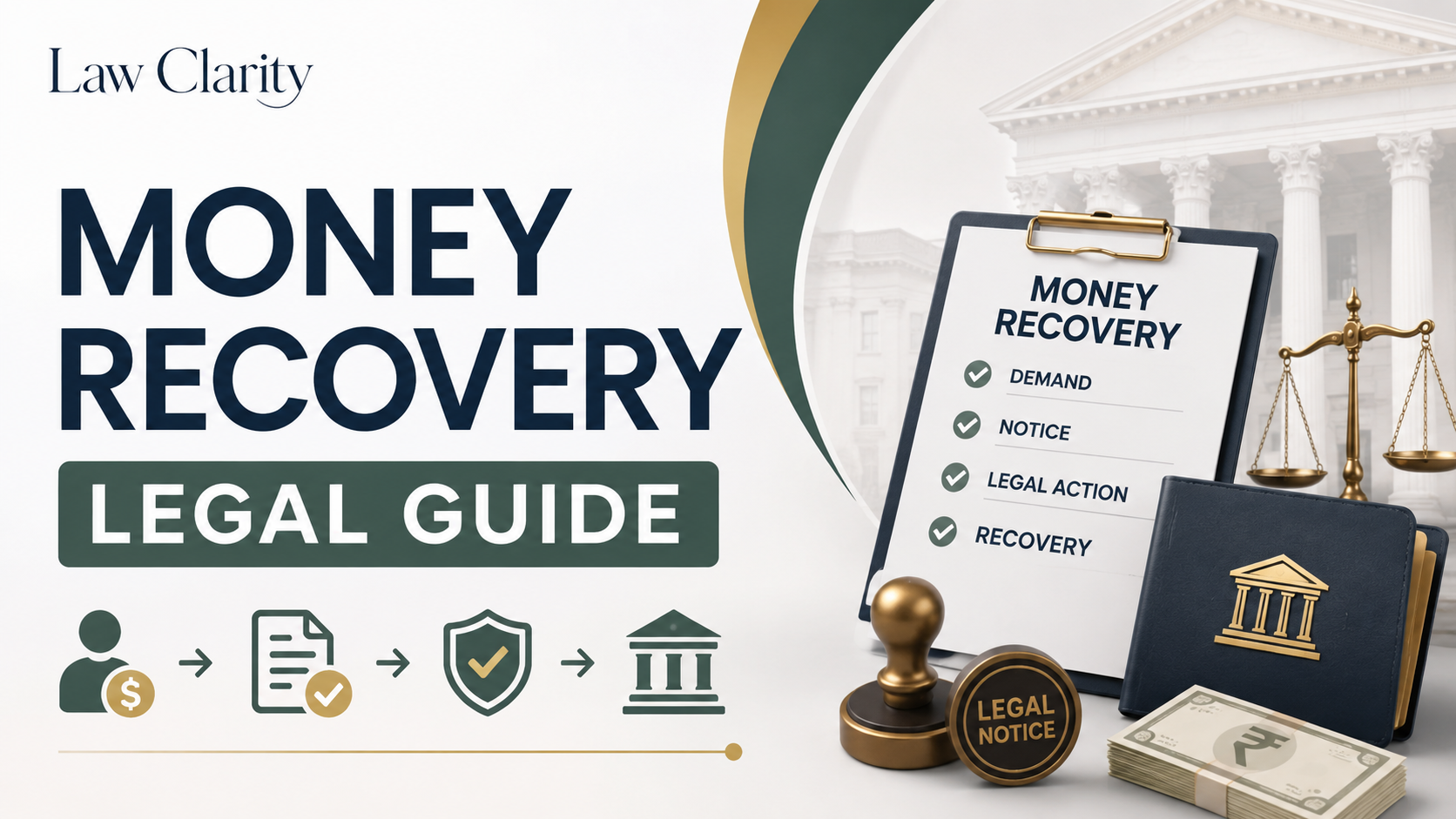
If you are searching for what to do if someone does not return money in India 2026, you are not alone. Many people lend money to friends, relatives, tenants, or business contacts and later struggle to recover it. The situation can feel stressful, especially when the other person stops responding or keeps delaying repayment.
This article explains the practical legal steps you can take in India to recover your money. It covers friendly follow-ups, legal notice, police complaint in case of fraud, and civil court recovery options. This is general legal information only, not legal advice. For your specific situation, you should speak with a qualified lawyer.
---
Quick Answer
If someone does not return your money in India, start with a polite reminder and written follow-up. If that fails, send a legal notice through a lawyer. If there is cheating or fraud, you may file a police complaint. For recovery, you can file a civil suit in court. The exact option depends on proof, amount, and facts of your case.
---
Key Takeaways
- Always try a written follow-up before taking legal action
- A legal notice is often the first formal step
- Police complaints apply mainly in fraud or cheating cases
- Civil suits are used for actual money recovery
- Proper documents and proof are very important
- Time limits may apply, so do not delay action
- Legal process depends on facts and evidence
---
Table of Contents
- Why People Face Money Recovery Issues
- Friendly Follow-Up and Informal Recovery
- Legal Notice for Money Recovery in India
- Police Complaint for Money Not Returned
- Civil Suit for Recovery of Money
- Step by Step Process
- Documents or Details to Keep Ready
- Simple Example
- Common Mistakes People Should Avoid
- Official Links to Verify
- When Should You Speak to a Lawyer
- FAQs
- Final Thoughts
---
Why People Face Money Recovery Issues
Money disputes usually happen in everyday situations:
- Personal loans without written agreement
- Business transactions without invoices or contracts
- Security deposits not returned by landlords
- Freelance or salary payments delayed
- Online fraud or cheating
In many cases, the main problem is lack of written proof. Courts and authorities rely heavily on documents, messages, or bank records.
---
Friendly Follow-Up and Informal Recovery
Before taking legal steps, try resolving the issue calmly.
What you can do
- Call or message the person politely
- Send a clear repayment reminder on WhatsApp or email
- Mention the amount and date of payment
- Keep records of all communication
Why this matters
Sometimes disputes happen due to misunderstandings or temporary financial issues. A written reminder creates proof that you asked for your money.
---
Legal Notice for Money Recovery in India
If reminders do not work, the next step is a legal notice.
What is a legal notice?
A legal notice is a formal letter sent through a lawyer demanding repayment within a specific time.
What it includes
- Your details and the other party’s details
- Amount due
- Reason for payment
- Deadline to repay
- Warning of legal action
Why it is important
- Shows seriousness
- Creates legal record
- Sometimes leads to settlement without court
You can learn about legal frameworks from the India Code, which publishes Indian laws.
---
Police Complaint for Money Not Returned
Many people ask if they can go to the police.
Important point
Police generally do not handle simple loan disputes. These are civil matters.
When police complaint is possible
You may file a complaint if there is:
- Cheating or fraud
- False promise with dishonest intention
- Online scam or cyber fraud
In such cases, you can report at the National Cyber Crime Reporting Portal if the issue involves online fraud.
---
Civil Suit for Recovery of Money
If the person still does not pay, you can file a civil suit for recovery of money.
Where to file
- Civil court based on jurisdiction
- Location depends on where transaction happened or parties live
You can check court information through eCourts Services.
What the court does
- Examines documents and evidence
- Hears both parties
- Passes an order based on facts
Important note
Court process takes time and depends on evidence, court workload, and legal arguments.
---
Legal Options at a Glance
| Option | When to Use | Outcome Type |
|---|---|---|
| Friendly follow-up | Initial stage | Informal resolution |
| Legal notice | Payment delay continues | Formal demand |
| Police complaint | Fraud or cheating | Criminal investigation |
| Civil suit | Money recovery required | Court order |
---
Step by Step Process
Step 1: Collect proof
Gather all documents such as bank transfers, messages, agreements, or receipts.
Step 2: Send reminder
Send a written message with clear details of the amount and deadline.
Step 3: Send legal notice
Contact a lawyer to send a formal legal notice.
Step 4: Evaluate fraud angle
If there was cheating or false promise, consider filing a police complaint.
Step 5: File civil case
If no response, file a recovery suit in civil court.
Step 6: Track your case
Use eCourts Services to check case status.
---
Documents or Details to Keep Ready
Prepare the following:
- Bank transfer proof or transaction history
- Written agreement or loan document
- WhatsApp chats, emails, SMS
- Any receipts or invoices
- Identity details of the other party
- Timeline of events
Having proper documents increases your chances of a smoother legal process.
---
Simple Example
Ravi lends ₹50,000 to his friend through bank transfer. The friend promises to return it in two months but stops responding.
Ravi sends reminders on WhatsApp and email. When there is no response, he sends a legal notice through a lawyer. The friend still does not pay.
Ravi then files a civil suit using his bank statement and chat records as proof. The court examines the case and proceeds based on evidence.
This example shows how the process usually works. The result depends on facts and proof.
---
Common Mistakes People Should Avoid
- Giving money without any written proof
- Waiting too long before taking action
- Filing police complaint for purely civil disputes
- Not keeping records of communication
- Sending emotional or threatening messages
- Ignoring legal notice deadlines
Avoiding these mistakes can make your case stronger.
---
Official Links to Verify
Always verify the latest process and rules from official sources.
---
When Should You Speak to a Lawyer?
You should consider consulting a lawyer if:
- The amount involved is significant
- There is no written agreement
- The other party is denying the transaction
- You received or want to send a legal notice
- You are planning to file a civil suit
- There is possible fraud or cheating
A lawyer can guide you based on your documents and facts.
---
FAQs
Can I file a police complaint if someone does not return money?
Only if there is fraud or cheating. Simple loan disputes are usually civil matters.
Is a legal notice mandatory before filing a case?
It is not always mandatory, but it is commonly used as a first legal step.
What proof is required to recover money?
Bank records, agreements, messages, and any written acknowledgment help support your case.
How long does a money recovery case take?
It depends on the court, evidence, and complexity of the case. Timelines vary.
Can I recover money without going to court?
Yes, through settlement after reminders or legal notice, if the other party agrees.
What if I gave money in cash?
Recovery may be harder without proof. Any supporting evidence like witnesses or messages may help.
Is there a time limit to file a case?
Yes, limitation periods may apply depending on the case. You should verify with a lawyer.
Can online fraud cases be reported separately?
Yes, you can report online fraud on the National Cyber Crime Reporting Portal.
---
Final Thoughts
Recovering money in India requires patience, proper documentation, and the right legal steps. Start with simple communication, move to legal notice if needed, and consider court action only when necessary.
Every case depends on facts, proof, and timing. For proper guidance tailored to your situation, it is best to consult a qualified lawyer before taking legal action.