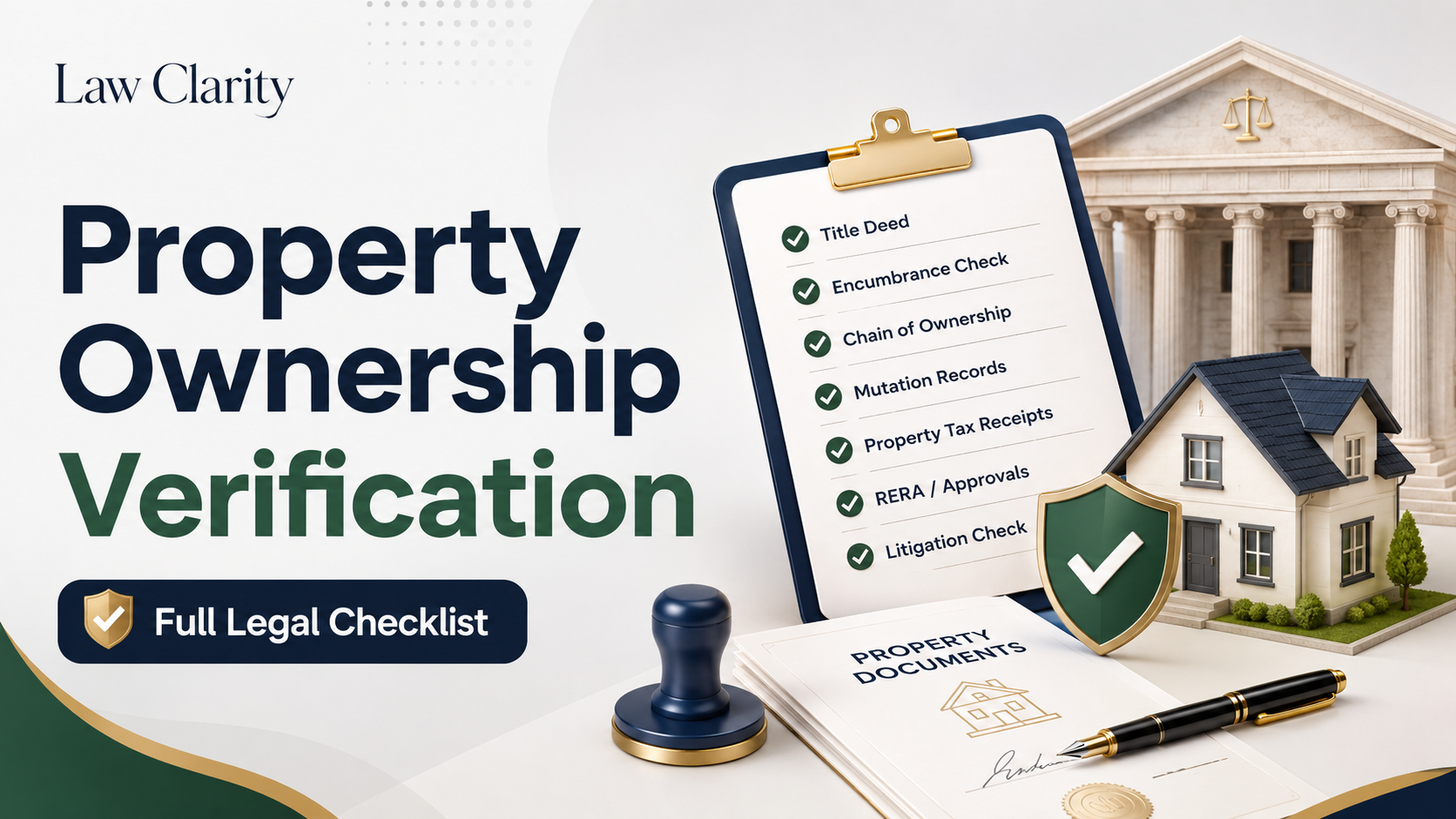
If you are planning to buy land, a flat, a house, or even take a commercial property on long-term lease, knowing how to verify property ownership in India is one of the most important steps. Property fraud, disputed titles, unregistered transfers, and hidden loans can create serious legal and financial problems. A proper property ownership verification process helps you confirm that the seller has a valid and marketable title.
This guide explains the practical process of property ownership verification in India, including title documents, Encumbrance Certificate, mutation records, tax receipts, approved plans, RERA registration, and online land record checks. It is useful for property buyers, tenants, landlords, and small business owners.
This article is general legal information only and not legal advice. Property laws and land records can vary from state to state, and you should consult a qualified property lawyer for advice on your specific transaction.
Quick Answer
To verify property ownership in India, you should check the registered sale deed, title chain for at least 30 years, Encumbrance Certificate, mutation records, property tax receipts, approved building plans, and RERA details where applicable. You should also inspect state land records online and confirm that the property is free from disputes, mortgages, and unauthorized construction. For significant transactions, a property lawyer should conduct title due diligence and issue a title search report.
Key Takeaways
- Always verify the registered title documents and ownership chain.
- Obtain an Encumbrance Certificate to check registered transactions and charges.
- Check mutation entries and revenue records to confirm current ownership.
- Review property tax receipts and utility bills.
- Confirm municipal approvals and sanctioned building plans.
- Verify RERA registration for applicable real estate projects.
- Engage a property lawyer for a title search report before purchase.
Table of Contents
- Why Property Ownership Verification Is Important
- Main Documents to Verify Before Buying Property
- Encumbrance Certificate and Title Search
- Online Land Record Check in India
- RERA Verification for Flats and Projects
- Step by Step Process
- Documents or Details to Keep Ready
- Simple Example
- Common Mistakes People Should Avoid
- Official Links to Verify
- When Should You Speak to a Lawyer?
- FAQs
- Final Thoughts
Why Property Ownership Verification Is Important
Property ownership verification confirms whether the seller legally owns the property and has the right to transfer it.
Without proper due diligence, a buyer may face issues such as:
- Forged title documents
- Multiple sales of the same property
- Existing mortgages or loans
- Family disputes and inheritance claims
- Court cases or stay orders
- Unauthorized construction
- Missing government approvals
A clear title means the ownership is legally valid, transferable, and reasonably free from disputes or encumbrances.
Main Documents to Verify Before Buying Property
The following documents form the core of a property title verification checklist.
Registered Sale Deed
The sale deed is the primary ownership document showing how the seller acquired the property.
Check:
- Name of the owner
- Property description and boundaries
- Registration details
- Stamp duty payment
- Whether the seller's name matches identity documents
Title Chain Documents
Review previous ownership documents for at least 30 years where possible.
These may include:
- Earlier sale deeds
- Gift deeds
- Partition deeds
- Release deeds
- Probate or succession documents
- Court decrees
Mother Deed
In many states, the mother deed traces the original ownership history of the property.
Mutation Records
Mutation updates ownership in municipal or revenue records for tax purposes.
Mutation alone does not create title, but it supports possession and ownership records.
Property Tax Receipts
Recent tax receipts help confirm that municipal taxes are being paid and that the seller is recognized by local authorities.
Khata, Patta, Jamabandi, Record of Rights
Different states use different names for land and municipal records.
Examples include:
- Khata in Karnataka
- Patta and Chitta in Tamil Nadu
- Jamabandi in several northern states
- Record of Rights (RoR) in many states
Possession Letter and Occupancy Certificate
For apartments and new developments, check:
- Possession letter
- Occupancy Certificate (OC)
- Completion Certificate (CC)
Approved Building Plan
Verify that the construction was sanctioned by the competent municipal authority or development authority.
Encumbrance Certificate and Title Search
What Is an Encumbrance Certificate?
An Encumbrance Certificate (EC) shows registered transactions affecting the property, such as:
- Sale deeds
- Mortgages
- Gift deeds
- Releases
- Leases, where registered
It is one of the most important documents in sale deed verification and property due diligence.
Limitations of an Encumbrance Certificate
An EC generally reflects only registered transactions. It may not show:
- Unregistered agreements
- Pending court cases
- Certain statutory dues
- Possession disputes
What Is a Title Search Report?
A property lawyer can conduct a title search report in India by examining documents, registration records, and legal issues. The report usually comments on:
- Ownership chain
- Encumbrances
- Missing documents
- Risks and defects in title
Online Land Record Check in India
Many states provide online land records under the Digital India Land Records Modernization Programme.
A land record check online in India may include:
- Record of Rights
- Mutation status
- Survey details
- Ownership entries
These records are useful for preliminary verification, but original documents should still be examined.
RERA Verification for Flats and Projects
If you are purchasing a flat in a project that falls under the Real Estate (Regulation and Development) Act, 2016, verify the project on the relevant State RERA website.
Check:
- Project registration number
- Promoter details
- Approved plans
- Completion timeline
- Litigation disclosures
RERA registration improves transparency but does not replace independent title verification.
Property Ownership Verification Checklist
| Document or Record | Why It Matters |
|---|---|
| Registered sale deed | Confirms ownership transfer |
| Previous title deeds | Establishes ownership history |
| Encumbrance Certificate | Reveals registered charges and transactions |
| Mutation records | Shows ownership in revenue or municipal records |
| Property tax receipts | Indicates taxes are paid |
| Approved building plan | Confirms authorized construction |
| Occupancy Certificate | Shows building is approved for occupation |
| RERA registration | Helps verify project details |
| Identity documents | Confirms seller identity |
| Title search report | Provides legal due diligence opinion |
Step by Step Process
Step 1: Collect Basic Property Documents
Ask the seller for copies of:
- Sale deed
- Previous title documents
- EC
- Tax receipts
- Mutation records
- Approved plans
- Identity proof
Step 2: Match Ownership Details
Ensure the seller's name matches the title documents, PAN, Aadhaar, and other identification records.
Step 3: Verify Registration Details
Check that the deed was properly registered with the relevant Sub-Registrar.
Step 4: Obtain an Encumbrance Certificate
Apply through the state's registration department portal or office.
Step 5: Check Land Records Online
Use the relevant state land records portal to review ownership and survey details.
Step 6: Verify Municipal Approvals
Confirm sanctioned plans, completion certificates, and occupancy certificates where applicable.
Step 7: Search RERA Records
For under-construction or recently developed projects, verify details on the applicable State RERA website.
Step 8: Inspect Physical Possession
Visit the property and compare actual boundaries and occupation status with documents.
Step 9: Ask About Loans and NOCs
If the property is mortgaged, obtain documents showing that the lender's charge has been or will be cleared.
Step 10: Consult a Property Lawyer
Before paying a substantial amount, obtain a legal opinion and title search report.
Documents or Details to Keep Ready
When conducting property due diligence in India, keep the following checklist:
- Seller's full name and contact details
- Property address and survey number
- Sale deed copy
- Previous title documents
- Encumbrance Certificate
- Mutation records
- Property tax receipts
- Approved building plans
- Occupancy or Completion Certificate
- RERA registration details
- Identity and PAN of seller
- Loan closure documents, if applicable
Simple Example
Rohit plans to buy a resale apartment in Gurugram for ₹85 lakh. The seller provides the sale deed and tax receipts. Rohit obtains an Encumbrance Certificate and finds that the property was previously mortgaged to a bank. The seller then shares a loan closure letter and documents showing that the charge has been released. Rohit also checks the project's RERA registration and obtains a lawyer's title search report before signing the agreement to sell.
Common Mistakes People Should Avoid
- Relying only on photocopies without checking originals.
- Assuming mutation records alone prove ownership.
- Skipping the Encumbrance Certificate.
- Not checking for bank loans or mortgage releases.
- Ignoring unauthorized construction or missing approvals.
- Paying a large token amount before due diligence.
- Failing to verify the identity and authority of the seller.
- Not consulting a property lawyer for high-value transactions.
Official Links to Verify
Department of Land Resources, Government of India
Digital India Land Records Modernization Programme
National Portal of India Land Records Services
When Should You Speak to a Lawyer?
You should consult a qualified property lawyer if:
- The property value is significant.
- Title documents are incomplete.
- Ownership has changed multiple times.
- The property was inherited or subject to family settlement.
- There is an existing loan or mortgage.
- Court cases or notices are discovered.
- Construction approvals are missing.
- You are entering a long-term commercial lease.
A lawyer can review documents, identify legal risks, and prepare a title search report based on the available records.
FAQs
How many years of title documents should be checked in India?
Lawyers often review the ownership chain for around 30 years where records are available, but the exact period may depend on the nature of the property and state practices.
Is an Encumbrance Certificate enough to confirm ownership?
No. An Encumbrance Certificate is important but should be checked along with title deeds, mutation records, tax receipts, approvals, and legal due diligence.
Can I verify property ownership online in India?
Yes, many states provide online land record portals. These records are useful for preliminary checks but should be supported by original documents.
Does mutation prove legal ownership?
Mutation is an administrative record for tax and revenue purposes. It supports ownership but does not by itself establish title.
How do I verify a flat in a new project?
Check the sale documents, approved plans, Occupancy Certificate, and RERA registration details, and obtain a legal opinion before purchase.
What is a title search report?
It is a legal report prepared by a property lawyer after reviewing ownership documents, registration records, and related legal issues.
Should tenants also verify ownership?
Yes. Tenants, especially those entering commercial or long-term leases, should confirm that the landlord is authorized to lease the property.
Can a property still have disputes even if documents look complete?
Yes. Some disputes or claims may not be apparent from documents alone. A lawyer can help assess legal risks based on the facts and available records.
Final Thoughts
Verifying property ownership in India requires more than checking one document. You should review the sale deed, title history, Encumbrance Certificate, mutation records, tax receipts, approvals, and RERA details where relevant. Online land records and official portals are useful starting points, but they do not replace careful legal due diligence.
Every property transaction depends on its facts, documents, state-specific procedures, and any pending disputes. Before making a major payment or signing a sale or lease agreement, it is wise to consult a qualified property lawyer for advice tailored to your situation.