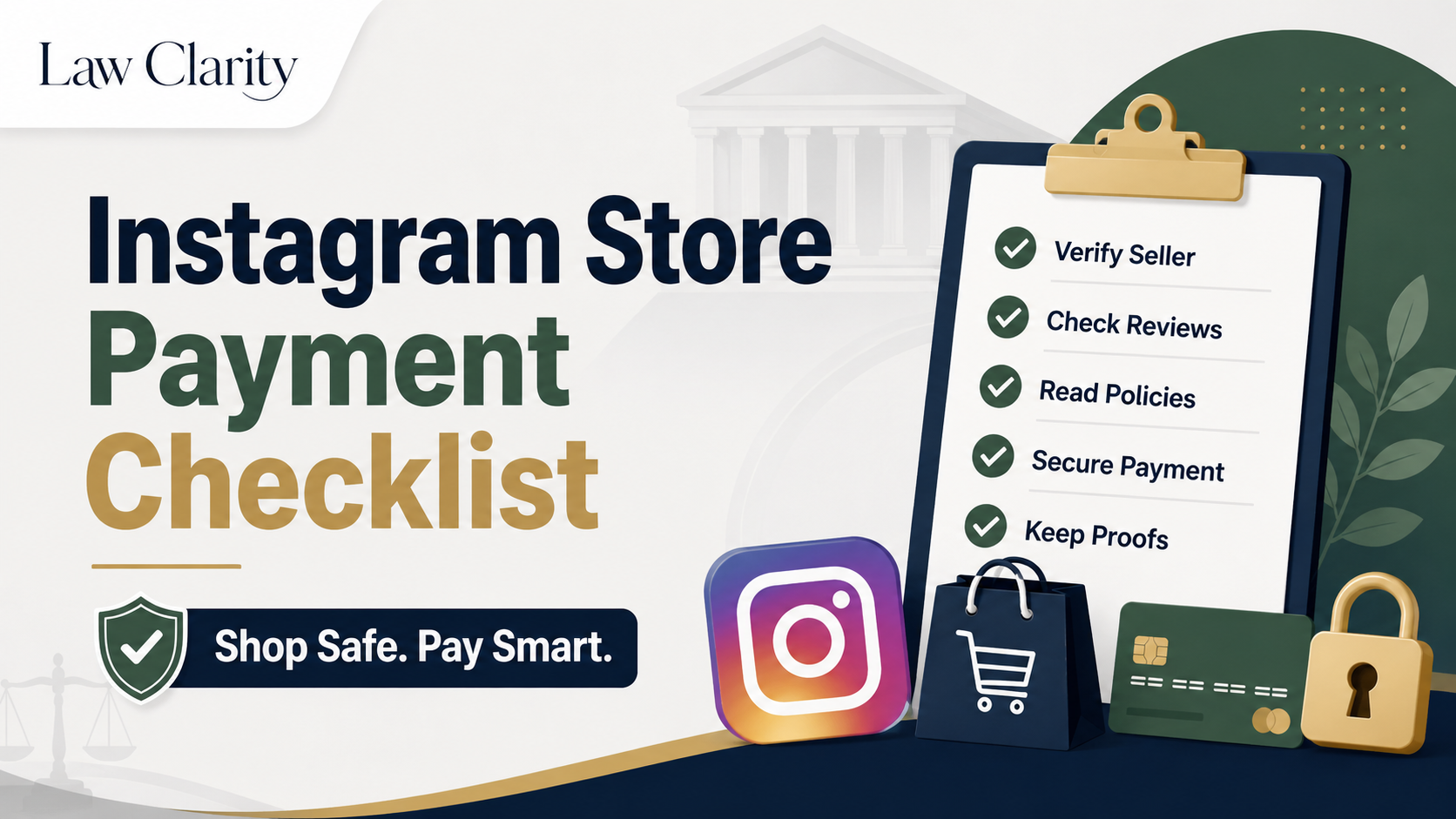
Instagram has become a popular place for shopping. Many small businesses, home-based sellers, and established brands use Instagram to sell products directly to customers. At the same time, complaints about fake stores, non-delivery of products, misleading advertisements, and payment scams have also increased.
If you are searching for things to remember before paying any Instagram store, it is a good idea to verify the seller before sending money. A few simple checks can help you avoid unnecessary disputes and reduce the risk of fraud.
This article explains practical precautions, common warning signs, documentation to keep, and the complaint options available in India if a problem arises. This article is general legal information only and not legal advice.
Quick Answer
Before paying any Instagram store, verify that the seller is genuine, check customer reviews, read the return and refund policy, confirm contact details, and avoid making payments without proper order confirmation.
Keep screenshots of the product listing, chats, payment receipts, and seller details. If you face a problem such as non-delivery or suspected fraud, you may consider reporting the matter through the National Cyber Crime Reporting Portal or seeking assistance through consumer grievance mechanisms, depending on the facts of the case.
Key Takeaways
- Verify the seller before making payment.
- Check reviews from sources outside Instagram.
- Read the return, refund, and shipping policies carefully.
- Avoid paying solely based on attractive discounts.
- Keep screenshots of chats, listings, and payment receipts.
- Be cautious if a seller insists on payment to a personal account without proper business details.
- Know the official complaint options available if a dispute occurs.
Table of Contents
Why Instagram Shopping Requires Caution
How to Verify an Instagram Store
Red Flags That May Indicate a Scam
Understanding Payment and Refund Risks
Step by Step Process
Documents or Details to Keep Ready
Simple Example
Common Mistakes People Should Avoid
Official Links to Verify
When Should You Speak to a Lawyer?
FAQs
Final Thoughts
Why Instagram Shopping Requires Caution
Instagram allows businesses to reach customers directly. Many genuine sellers operate through social media and provide quality products and services.
However, Instagram also makes it easy for dishonest individuals to create attractive profiles, post copied product photographs, collect payments, and disappear. In some situations, buyers receive products that are significantly different from what was advertised. In others, products are never delivered.
Unlike large e-commerce marketplaces that may offer structured dispute resolution systems, some Instagram stores operate independently. This means buyers should perform basic checks before making any payment.
How to Verify an Instagram Store
Check the Account History
A newly created account with very few posts may require additional verification. Look at:
- How long the account has been active
- Consistency of posts
- Customer interactions
- Story highlights
- Business information
An account with years of activity is not automatically genuine, but a longer history can provide additional context.
Review Customer Feedback Carefully
Do not rely only on comments shown on the seller's page.
Consider checking:
- Google reviews if available
- Website reviews
- Other social media profiles
- Customer discussions on public platforms
Be cautious if all reviews appear identical or unusually promotional.
Look for Clear Contact Information
A genuine business often provides:
- Phone number
- Email address
- Business address
- Customer support information
If the seller refuses to share basic contact details, consider proceeding carefully.
Check for a Website
Many genuine businesses maintain a website in addition to their Instagram account.
A website may provide:
- Terms and conditions
- Shipping policies
- Return policies
- Business information
The absence of a website does not automatically mean a store is fraudulent, but additional verification may be useful.
Verify Business Details
Where applicable, ask for:
- Business name
- Invoice details
- GST information if relevant
A seller unwilling to provide any business information may warrant caution.
Red Flags That May Indicate a Scam
Certain warning signs frequently appear in online shopping disputes.
Unrealistic Discounts
Products advertised at extremely low prices compared to market rates should be examined carefully.
Urgent Payment Pressure
Be cautious if the seller says:
- Offer expires in minutes
- Last item available
- Pay immediately or lose the deal
Pressure tactics are commonly used to discourage verification.
No Return or Refund Information
A genuine seller should usually explain their policy clearly.
If no policy exists, ask questions before making payment.
Disabled Comments
Some sellers disable comments to prevent customers from sharing complaints publicly.
This alone is not proof of wrongdoing, but it may justify additional checks.
Copied Product Photos
Performing a reverse image search may help identify whether product photographs have been copied from another source.
Payment Only Through Personal Accounts
If a seller refuses invoices and requests payment exclusively through a personal account without proper business information, proceed carefully.
Understanding Payment and Refund Risks
Many consumers assume that payment automatically guarantees delivery or a refund if a problem occurs. In reality, outcomes depend on the facts of each situation.
Before paying, review the following:
| Item | What to Check |
|---|---|
| Product Details | Size, colour, specifications, quantity |
| Price | Total payable amount including shipping |
| Delivery Time | Estimated dispatch and delivery timeline |
| Return Policy | Conditions for returns |
| Refund Policy | Whether refunds are available and under what circumstances |
| Contact Information | Phone, email, and support details |
| Order Confirmation | Written confirmation of purchase |
If any of these details are unclear, ask questions before payment.
What Information Should Be Confirmed Before Payment?
Product Description
Ensure the description matches your expectations.
Check:
- Material
- Size
- Features
- Warranty information if applicable
Delivery Commitments
Ask:
- When will the product be dispatched?
- Which courier service will be used?
- Will tracking information be provided?
Return Conditions
Read return terms carefully.
Some products may not be eligible for returns due to hygiene, customization, or other reasons.
Payment Method
Use payment methods that create a transaction record.
Avoid cash arrangements that leave no documentation.
Step by Step Process
Step 1: Verify the Seller
Review the Instagram profile, business information, reviews, and account activity.
Step 2: Check Policies
Read shipping, return, exchange, and refund policies.
Step 3: Request Order Confirmation
Ask the seller to confirm:
- Product details
- Final price
- Delivery timeline
Step 4: Keep Screenshots
Save:
- Product listing
- Seller profile
- Chat conversations
- Policy pages
Step 5: Make Payment Carefully
Use a payment method that generates a receipt or transaction record.
Step 6: Save Payment Proof
Keep screenshots and payment references.
Step 7: Follow Up Professionally
If delivery is delayed, communicate politely and maintain records of all conversations.
Step 8: Explore Complaint Options if Needed
Depending on the circumstances, you may consider:
- Contacting the seller formally
- Using consumer grievance mechanisms
- Reporting suspected cyber fraud through official channels
Documents or Details to Keep Ready
Maintain the following records:
- Screenshots of product advertisements
- Seller profile screenshots
- Chat conversations
- Payment receipts
- Bank transaction records
- UPI transaction details
- Order confirmations
- Delivery commitments
- Invoice or bill, if provided
- Emails exchanged with the seller
These records may be useful if a dispute arises later.
Simple Example
A customer sees a clothing store on Instagram advertising branded products at unusually low prices.
Before making payment, the customer checks reviews, requests business details, asks about returns, and saves screenshots of the product listing. The customer also keeps the payment receipt and order confirmation.
If a dispute later occurs regarding delivery or product quality, the customer has documentation that may help explain the facts to the relevant authority or a qualified lawyer.
Common Mistakes People Should Avoid
- Paying immediately without verifying the seller.
- Ignoring return and refund policies.
- Failing to save screenshots of chats and advertisements.
- Assuming that every Instagram business is verified.
- Trusting only positive comments on the seller's page.
- Sending money without obtaining order confirmation.
- Deleting transaction receipts after payment.
- Not checking whether the seller provides contact information.
What Can You Do If You Suspect Fraud?
If you believe you may have been a victim of online fraud, consider gathering all relevant evidence and reviewing the available reporting options.
Depending on the circumstances, useful records may include:
- Screenshots
- Payment details
- Communication records
- Seller profile information
For suspected cyber fraud, information can be reported through the National Cyber Crime Reporting Portal.
Consumer disputes involving products or services may require different remedies depending on the facts involved.
Official Links to Verify
National Cyber Crime Reporting Portal
Indian Cyber Crime Coordination Centre (I4C)
eDaakhil Consumer Complaint Portal
Department of Consumer Affairs
When Should You Speak to a Lawyer?
You may consider speaking with a qualified lawyer if:
- A significant amount of money is involved.
- You suspect identity misuse or impersonation.
- The seller has stopped responding entirely.
- You receive misleading legal threats.
- Multiple buyers appear to be affected.
- There are questions regarding consumer rights or available legal remedies.
- You are unsure about the appropriate legal process.
A lawyer can assess the specific facts of your situation and explain the options that may be available.
FAQs
Is it safe to buy from Instagram stores?
Many Instagram stores are genuine businesses. However, buyers should verify sellers and keep proper records before making payment.
Can I trust a store just because it has many followers?
No. A large follower count does not automatically prove authenticity. Additional verification is advisable.
Should I keep screenshots before paying?
Yes. Screenshots of product listings, chats, and payment confirmations can be useful if a dispute arises.
What if the product never arrives?
The appropriate response depends on the facts. Keep records, communicate with the seller, and review available consumer or cyber complaint options where relevant.
Is a refund guaranteed if an Instagram seller does not respond?
No. Outcomes depend on the facts, available evidence, applicable laws, and the actions taken by the parties involved.
Should I ask for an invoice?
Where applicable, requesting an invoice or written order confirmation is a good practice.
Can I report suspected online fraud?
Yes. Suspected cyber fraud may be reported through the National Cyber Crime Reporting Portal.
Are return and refund policies legally important?
Yes. Understanding the seller's stated policies before payment can help you make an informed decision and reduce misunderstandings later.
Final Thoughts
Instagram shopping can be convenient, but it also requires caution. Taking a few minutes to verify a seller, review policies, and save important records can reduce the risk of disputes and misunderstandings.
If a problem arises, preserve all available evidence and review the official complaint channels that may apply to your situation. Legal outcomes depend on the specific facts of each case, and you should consult a qualified lawyer for advice tailored to your circumstances.